Crawl space moisture control addresses subfloor structural vulnerabilities caused by the humid subtropical climate of the Tennessee Valley, where summer ambient relative humidity consistently exceeds 70 percent. In…
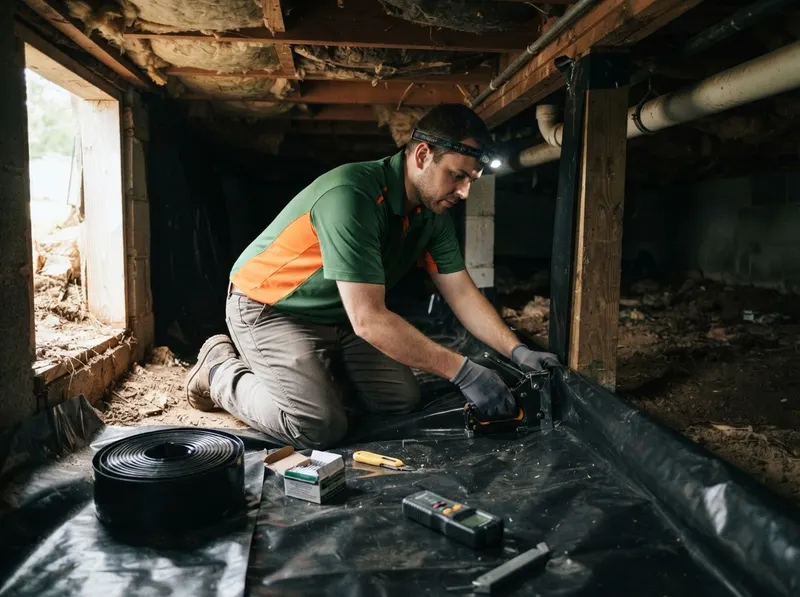
Crawl space moisture control addresses subfloor structural vulnerabilities caused by the humid subtropical climate of the Tennessee Valley, where summer ambient relative humidity consistently exceeds 70 percent. In riverfront pockets like North Shore and historic valley parcels across St. Elmo and Highland Park, unsealed perimeter foundation vents pull warm, moisture-laden outdoor air directly beneath cool floor assemblies. When this ambient air contacts chilled HVAC ductwork and subfloor sub-framing, condensation forms along yellow pine joists and sills. According to structural guidelines published by the USDA Forest Products Laboratory, wood moisture equivalent readings exceeding 19 percent establish viable colonization thresholds for decay fungi like Serpula lacrymans and attract subterranean termite foraging tubes. Regulating this substructure dampness eliminates the high-moisture ecology that drives severe interior infestations without requiring indiscriminate broad-spectrum chemical drenching throughout living spaces.
Effective foundation moisture mitigation relies on the targeted physical standards established by the Building Energy Codes Program, which outlines closed crawl space configurations. The process begins by raking out native soil surfaces to remove sharp limestone gravel and decaying organic matter that shelter shelter-seeking subterranean pests. Technicians install a continuous, puncture-resistant 12-mil or 20-mil virgin polyethylene ground sheet across the dirt floor, overlapping seams by 12 inches and sealing them with heavy-duty acrylic vapor tape. The membrane laps up masonry foundation walls and support piers, anchoring at least 6 inches above outside grade while leaving a mandatory 3-inch gap below sill plates. This perimeter gap preserves the visual inspection zone specified in the pest barrier manuals from the National Pest Management Association, ensuring field crews can continuously monitor for termite exploratory mud tubes during future structural audits.
Water intrusion beneath river-plain foundations in Brainerd, East Ridge, and Red Bank frequently involves hydrostatic ground pressure during intense seasonal runoff from Lookout Mountain and Raccoon Mountain Reservoir. Where standing water pools against subgrade masonry, mitigation requires internal perforated perimeter French drains bedded in washed aggregate and piped to a sealed sump basin equipped with a dual-float check valve. To maintain dry conditions year-round, crews seal foundation vents with closed-cell expanded polystyrene panels adhering to fire-resistance metrics from the International Code Council. A high-efficiency, Energy Star-rated mechanical dehumidifier, draining automatically to the exterior or sump network, extracts between 70 and 105 pints of airborne water per day. Research from the EPA Indoor Air Quality division confirms that managing under-home humidity sharply lowers airborne fungal spores and dust mite allergens drawn into upstairs rooms via the stack effect.
Homeowners weighing structural investments often compare passive spot plastic laydowns against complete foundation sealing. Simple thin 6-mil unsealed plastic sheets laid directly over earth provide temporary evaporation resistance, but shifting soil, pest movement, and air drafts easily displace unanchored films, leaving soil moisture to escape into subfloors. Comprehensive closed-barrier systems involve higher initial material inputs, including continuous wall sealing, supply air distribution, and electrical line installations meeting the standards of the National Fire Protection Association, yet protect primary structural framing from irreversible wood rot. Field data from the Oak Ridge National Laboratory demonstrates that encapsulated foundations reduce whole-home energy loss by up to 15 percent by stabilizing floor temperatures above unconditioned foundation voids. Choosing full encapsulation is ideal for long-term real estate preservation, whereas targeted heavy ground sheeting paired with gravity-fed drainage lines serves properties with tight clearance or minimal side-wall seepage.
Every job gets a firm, written price after a free on-site visit.
Tell us about your crawl space moisture control job in Chattanooga and we'll send a clear, written quote, usually the same day.
 WestHaven Pest Services